Enneagram Centers and Triads: Body, Heart and Head Types
The nine Enneagram types fall into three centers: body, heart and head. Learn what each center focuses on, its core emotion, and other useful triads.
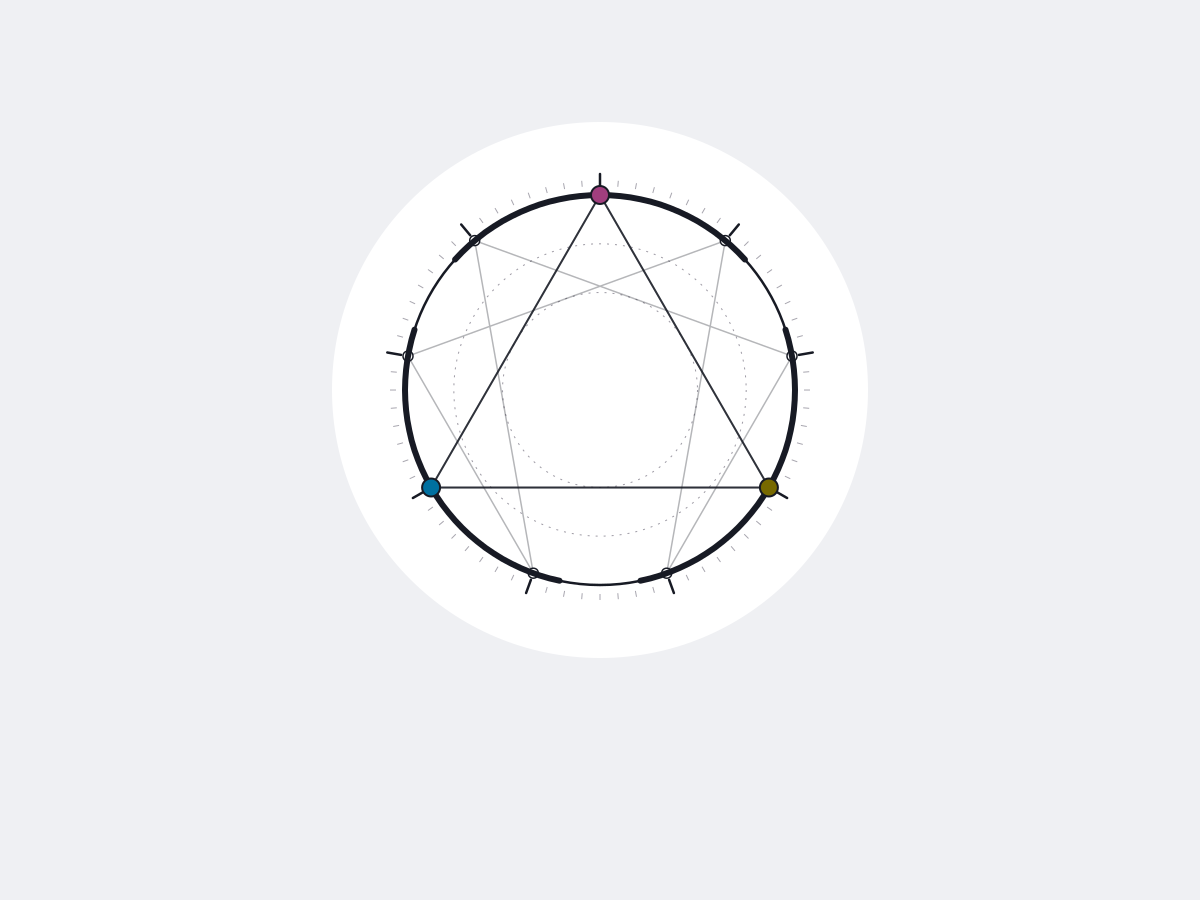
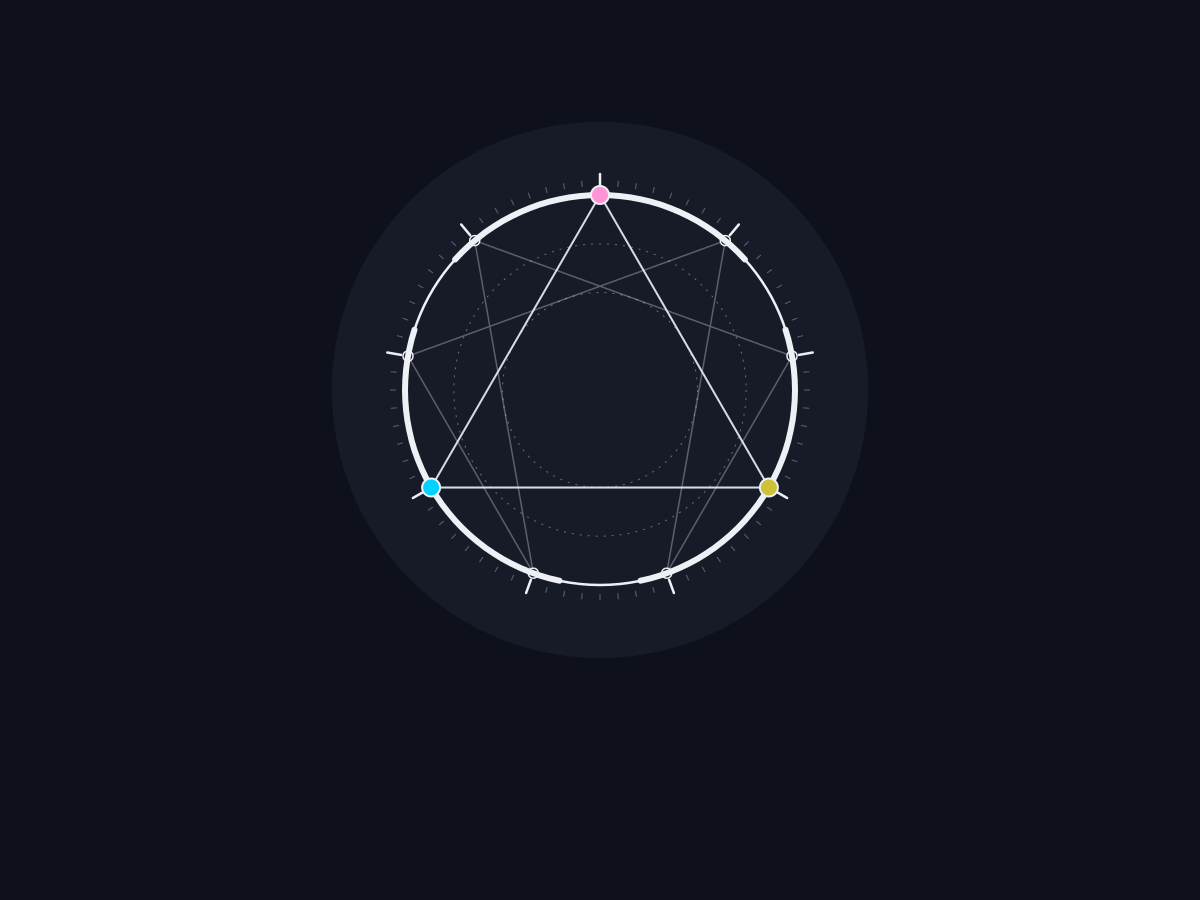
The Enneagram centers are three groups of three types: body, heart and head. Each center describes where a type tends to react first: through instinct, through feelings about worth and image, or through thinking and planning. Every person uses all three.
What are the three Enneagram centers?
The three centers group the nine types by where they tend to react first. Body types (8, 9, 1) lead with gut sense and a need for control. Heart types (2, 3, 4) lead with feelings about worth and how they are seen. Head types (5, 6, 7) lead with thinking, planning and a search for safety.
Imagine a plan at work falls apart without warning. A body type might feel a jolt of "this is not okay" and want to take charge, fix it, or step back to keep the peace. A heart type might first wonder how it reflects on them and on the team. A head type might start running scenarios and asking what else could go wrong. All three are useful responses. They just start in different places.
Centers are sometimes called intelligence centers or triads. Some books say gut center instead of body center. The ideas are the same.
What does each center focus on?
Each center has a theme and a feeling underneath it. The body center circles around anger and autonomy. The heart center circles around shame and worth. The head center circles around fear and certainty. That does not mean these types feel only one emotion. It means one feeling quietly shapes many of their choices.
Each type in a center deals with the shared feeling in its own way. That is what makes three types in the same center look so different on the surface.
How do the three types in each center differ?
Within each center, one type tends to push the feeling outward, one tends to tune it out, and one tends to turn it inward. In the body center, Eights show anger, Nines numb it, and Ones redirect it into high standards. The same three-way split shows up in the heart and head centers.
| Center | Pushes it outward | Tunes it out | Turns it inward |
|---|---|---|---|
| Body | Type 8 shows anger openly | Type 9 goes numb to it | Type 1 holds it as self-control |
| Heart | Type 2 seeks worth in others | Type 3 sets feelings aside to perform | Type 4 looks for worth inside |
| Head | Type 7 runs from fear toward fun | Type 6 swings between doubt and nerve | Type 5 pulls back to think |
Notice that the middle type in each center is a bit different. Types 3, 6 and 9 are the ones most cut off from their center's feeling. Many teachers say that is why these three sit on the inner triangle of the symbol. If you want to see how the lines link them, read our guide to stress and growth lines.
What other triads does the Enneagram use?
Besides the centers, many teachers group types by how they go after what they need. This draws on psychologist Karen Horney's idea that people move toward others, against others, or away from others. Types 1, 2 and 6 tend to move toward, 3, 7 and 8 against, and 4, 5 and 9 away.
Here is how we describe these three groups in plain words:
- Rule-minded (1, 2, 6): tend to meet needs by doing what is expected and earning their place.
- Push-forward (3, 7, 8): tend to meet needs by going straight after them.
- Step-back (4, 5, 9): tend to meet needs by pulling back into their own space.
These labels are our own. Other teachers use different names, and some add more triads still. You do not need all of them. The centers are the most widely used, and they are the ones our results show.
How do the centers show up in relationships?
Centers shape what each person reaches for first in a hard talk. A body type may want to settle who decides. A heart type may want to know the bond is still okay. A head type may want a clear plan. Knowing this helps two people stop talking past each other.
Pairs that cross centers often need to translate. In the 4 and 5 pair, a heart type and a head type may meet over depth and ideas, but one wants feelings named while the other wants time to think. In the 2 and 9 pair, a heart type meets a body type, and the work is often about saying out loud what each one needs. Other cross-center pairs, such as Types 5 and 8 across head and body, or Types 1 and 2 across body and heart, have their own patterns too.
How can you use your center for growth?
Start by naming your center and the feeling under it. Then notice when that feeling is steering you. Growth often means using the two centers you lean on less. A head type might practice feeling before planning. A body type might pause and think before acting. A heart type might act before checking how it looks.
- Find your core type's center in the table above.
- Name the feeling linked to it: anger, shame or fear.
- Notice one moment this week when that feeling steered you.
- Try one small step from a center you use less.
- Write down what changed, even if it felt awkward.
How do centers connect to Three-Center Type?
Because everyone uses all three centers, some teachers look at your strongest type in each one. The best-known version is tritype, a model developed by Katherine Fauvre. Our Three-Center Type feature builds on that idea and shows your top body, heart and head type from your test scores.
Read more in our Three-Center Type guide. It explains how the three types combine and how to read your own result.
What are the limits of the centers model?
The centers are a helpful way to organize the nine types, but they are a model, not a measurement. Research on the Enneagram is mixed, and few studies test the centers directly. Use them as a lens for noticing patterns, and trust your own experience when it does not match the book.
Some people find their center right away. Others see themselves in all three. Both are normal. If you are unsure, start with your test results and see which center your top scores fall in. Our guide to what the Enneagram is covers the full model.
Frequently asked questions
What are the three centers of the Enneagram?
The three centers are body (Types 8, 9 and 1), heart (Types 2, 3 and 4) and head (Types 5, 6 and 7). Each center describes where a type tends to react first.
What is a triad in the Enneagram?
A triad is any group of three types that share a theme. The best-known triads are the three centers, but teachers also group types by how they meet their needs.
Do I only use one center?
No. Everyone uses all three centers. Your type shows which one tends to lead, and growth often means drawing on the other two more.
Which center is the best?
None. Each center brings real strengths and its own blind spots. The model describes different ways of paying attention, not a ranking.
How do the centers relate to tritype?
tritype, a model developed by Katherine Fauvre, picks your strongest type from each of the three centers. Our version of the idea is called Three-Center Type.