Type 5
Enneagram Type 5: The Scholar
Type 5, the Scholar, seeks understanding and guards time and energy. Learn the core fear and desire, wings, stress and growth lines, and how Fives grow.
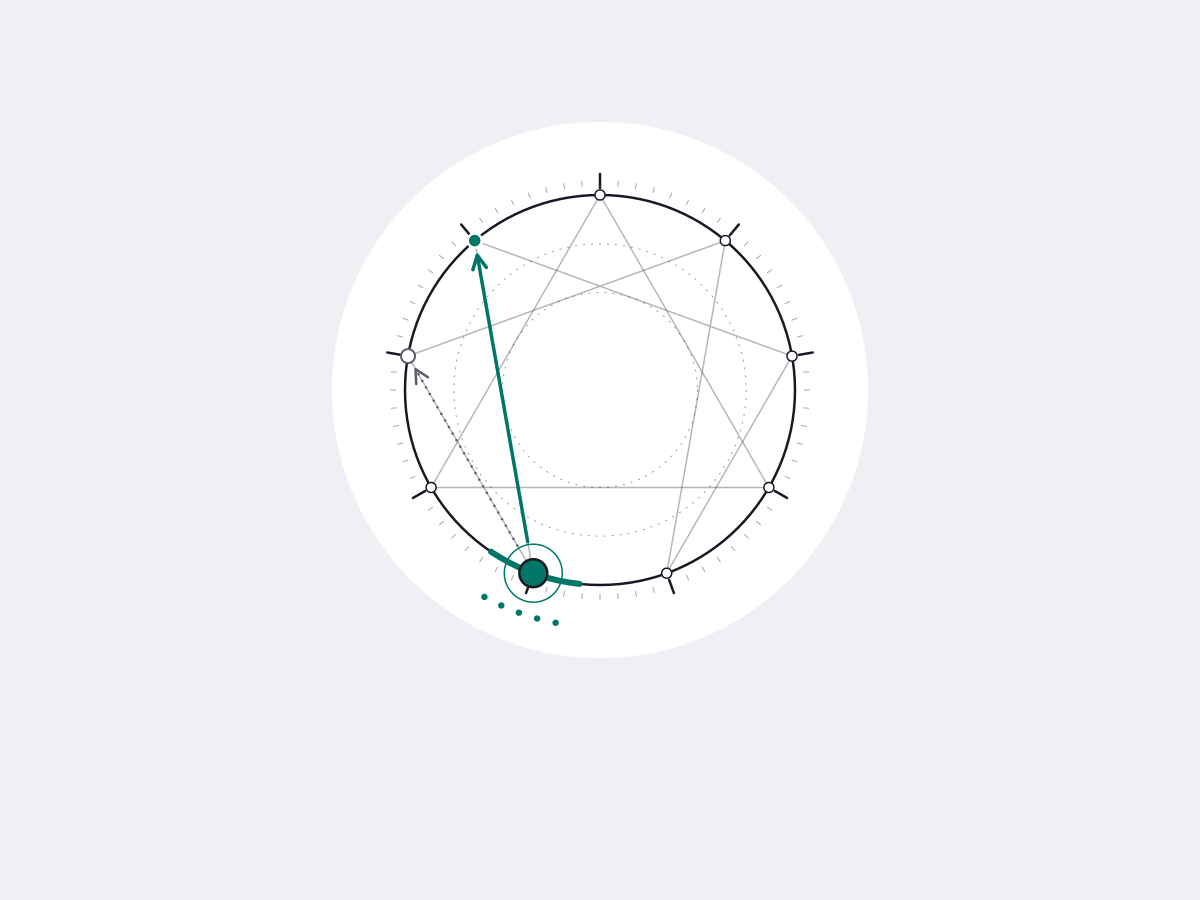

Enneagram Type 5, the Scholar, is a head-center type driven by the wish to understand the world and feel capable on their own terms. Fives tend to watch before they act, study what interests them in depth, and guard their time and energy closely.
What is a Type 5?
A Type 5 is someone whose attention goes first to understanding. Many Fives want to know how something works before they join in. They value privacy, dislike being rushed, and often feel that their energy is limited and needs managing. This is a common pattern among Fives, not a rule, and real people mix it with many other traits.
Think of the friend who reads three reviews and a forum thread before buying a kettle. Or the teammate who stays quiet for most of a meeting, then asks the one question that changes the plan. Or the cousin who leaves the party early, not because they are upset, but because they are simply done. These are small, everyday hints of the Five pattern.
Fives sit in the head center, with Type 6 and Type 7. All three head types tend to meet uncertainty with the mind. Sixes look for support and plans. Sevens look for options and new experiences. Fives look inward, gather information and build a private store of knowledge to rely on.
A Five's day often has a rhythm of going out and coming back. They may handle a full morning of calls with real skill, then close the door at lunch to read, tinker or simply sit in silence. That quiet hour is not a luxury to them. It is how they refill. When the rhythm breaks for too long, many Fives feel frayed and short on patience, even with people they love.
Wondering if you are a Five? Take the test first, then come back and see what fits.
Type 5 at a glance
| Trait | Type 5 |
|---|---|
| Center | Head (thinking) |
| Core fear | Being drained, overwhelmed or unable to cope |
| Core desire | To understand the world and feel capable |
| Vice | Avarice (holding back time, energy and self) |
| Virtue | Nonattachment |
| Wings | 5w4, 5w6 |
| Stress line | Toward Type 7, The Optimist |
| Growth line | Toward Type 8, The Powerhouse |
| Key strength | Clear thinking, focus and calm under pressure |
| Growth edge | Pulling away from people and waiting until they feel ready |
What drives a Type 5?
Fives are driven by a fear of being drained, overwhelmed or caught unprepared, and a desire to understand the world and feel capable. Their core motivation is to gather enough knowledge and inner space to meet life calmly. The traditional vice is avarice, and the virtue is nonattachment.
A core fear and a core desire sit under each type. For Fives, both are about energy and knowledge.
Core fear: being drained or caught unprepared
Many Fives feel that the world asks for more than they have to give. Social events, open-ended requests and strong emotions can all feel like withdrawals from a small bank account. The fear is of running dry, or of facing something they do not understand and cannot handle.
You can see this in small choices. A Five may want an agenda before a call. They may ask how long a visit will last. They may keep a mental exit plan for a party. None of this is rude. It is a way of making sure they will still have something left at the end of the day.
Core desire: to understand and feel capable
The bright side of that fear is a hunger to understand. Fives often dive deep into a subject, whether that is bird calls, old maps, coding, history or how a certain machine works. Knowing things well gives them a sense of footing. It says, "I can handle this."
Core motivation: knowledge plus inner space
Fives want two things that go together: enough knowledge to feel competent, and enough private space to think. With both, many Fives feel calm and generous. Without them, they tend to retreat further, as if saving fuel for a long winter.
Vice and virtue: avarice and nonattachment
The traditional vice linked with Type 5 is avarice. For Fives, it rarely means greed for money. It is more about holding on to time, energy, privacy and inner resources, and sharing less of themselves than they could.
The virtue is nonattachment. That does not mean coldness. It means trusting that there is enough, so they can give freely without fear of running out. A Five living this virtue can share what they know, show up for people and still feel whole.
What are the strengths of a Type 5?
Common Type 5 strengths are curiosity, calm in a crisis, independence, respect for boundaries and real insight into complex systems. Many Fives notice patterns others miss and think clearly when everyone else is upset. People often lean on them for a steady, well-informed point of view.
People often lean on Fives for their clear heads. Many Fives are:
- Curious. They follow questions far past the point where most people stop.
- Calm in a crisis. They can step back, look at the facts and think while others panic.
- Independent. They are often comfortable working alone and figuring things out.
- Respectful of boundaries. They tend not to pry, and they give others room.
- Insightful. They connect dots that others miss and see patterns in complex systems.
What are the growth edges of a Type 5?
Typical Type 5 growth edges are withdrawing too far, over-preparing before acting, living in the head, needing very little to avoid depending on others and keeping thoughts private when sharing would help. Each one is a protective habit that has gone a step too far.
The habits that protect a Five can also cut them off. Watch for:
- Withdrawing too far. Spending so much time alone that relationships thin out.
- Over-preparing. Waiting to act until they know "enough," which may never arrive.
- Living in the head. Treating feelings and body signals as less real than ideas.
- Minimizing needs. Getting by on very little to avoid depending on anyone.
- Holding back. Keeping thoughts and feelings private, even when sharing would help.
These are not failings. They are the spots where a useful habit has gone a step too far.
How do the wings change a Type 5?
A Five's wings are Type 4 and Type 6. A 5w4 tends to be more creative, unconventional and inward, drawn to ideas with meaning. A 5w6 tends to be more practical, structured and loyal to a group, drawn to solving clear problems. Most Fives lean one way.
Fives sit between Type 4 and Type 6 on the circle. Most lean more toward one side, though some draw on both equally.
Move the slider to see which wing shapes the type more.
Balanced between 5w4 and 5w6
5w4
A 5w4 is a Type 5 who leans toward Type 4. Many are inventive, independent and drawn to ideas at the edges of a field. They mix sharp thinking with an artistic or personal streak. They grow by engaging with the physical world and people, and by sharing ideas before they feel complete.
Read more about 5w45w6
A 5w6 is a Type 5 who leans toward Type 6. Many are logical, careful and focused on knowledge that is useful and reliable. They like systems, evidence and a plan for what could go wrong. They grow by trusting their own competence, moving from preparation into action, and letting people in.
Read more about 5w65w4: the imaginative Five
A 5w4 blends the Five's love of ideas with some of Type 4's depth of feeling and creative streak. These Fives may be drawn to art, philosophy, music theory, writing or any field where ideas meet meaning.
A 5w4 can be more unconventional and more private than a 5w6. They may feel a bit like an outsider and enjoy it. Their growth often involves staying engaged with the world instead of living in a rich inner landscape that no one else gets to visit.
5w6: the problem-solving Five
A 5w6 adds some of Type 6's practical focus and loyalty. These Fives often enjoy systems, technical work, science, research or any field with clear problems to solve.
A 5w6 may be more cautious, more structured and more connected to a group or cause. They tend to ask "Will this work?" as much as "Is this interesting?" Their growth often involves trusting their own judgment without needing to check every angle first.
What happens to a Type 5 under stress?
Under stress, Fives move along the stress line toward Type 7. They may scatter their attention, jump between projects, look for distraction and go wide instead of deep. This often feels like action but works as an escape. Picking one small step and resting the body can help.
The stress line for Fives points to Type 7, The Optimist. When a Five is tired or overloaded, they may take on traits of a Seven on a hard day.
That can look like:
- jumping from topic to topic without finishing anything
- starting new projects to avoid the one that feels heavy
- getting restless and looking for distraction rather than real rest
- talking fast and going wide, when they usually go deep
Picture a Five facing a scary deadline. Instead of working, they spend the evening learning a new programming language, ordering books on three unrelated topics and planning a trip they will not take. It feels like action, but it is a way to escape the pressure.
When you catch this shift, it can be a signal. Pause, pick one small next step and take a real break, one that rests the body as well as the mind.
The stress point can also offer something good. A healthy dose of the Seven's playfulness can help a Five lighten up and enjoy life instead of only studying it.
What does growth look like for a Type 5?
In growth, Fives move along the growth line toward Type 8. They act on what they know before every question is answered, speak up with confidence, notice signals from the body and take up space. Their sharp mind stays, and their knowledge starts to reach the world.
The growth line for Fives points to Type 8, The Powerhouse. When a Five feels secure, they often take on some of the Eight's confidence and directness.
Growth for a Five can look like:
- Acting on what they know. Moving from research to doing, even before every question is answered.
- Speaking up. Sharing their view in a meeting instead of keeping it in a notebook.
- Living in the body. Noticing hunger, tiredness and strength, and treating them as useful information.
- Taking up space. Trusting that their presence and needs are welcome.
A Five on this path keeps their sharp mind. What changes is that their knowledge starts to move out into the world, where it can make a difference.
What are the health states of a Type 5?
We use three health states. A thriving Five is curious, generous with knowledge and confident in acting. An everyday Five is private, analytical and careful with time. A stressed Five may isolate, scatter and grow cynical. These are snapshots, and anyone can move between them.
We use three health states: thriving, everyday and stressed. They are snapshots, not a ranking, and anyone can move between them.
| State | What it can look like in a Five |
|---|---|
| Thriving | Curious, generous with knowledge, engaged, confident in acting on insight |
| Everyday | Private, analytical, protective of time, more comfortable observing than doing |
| Stressed | Isolated, scattered, cynical, cut off from feelings and from other people |
Thriving
A thriving Five is a gift to the people around them. They share what they know freely. They can be warm and funny, often with a dry wit. They act on their ideas and trust that they have enough energy to do so.
Everyday
On a normal day, a Five may keep a careful budget of time and attention. They may enjoy a long evening with a book and feel a little drained by a busy weekend. They may know a lot about a few things and be content to keep that knowledge mostly to themselves.
Stressed
Under heavy stress, a Five may cut off contact, sleep and eat poorly and spend hours in their head. They may feel that the world is too much and that no one can help. If that goes on for a long time, reaching out to someone you trust, or to a licensed professional, is a strong move, not a weak one. The Enneagram can offer a lens, but it is not a substitute for real support.
How do the instincts shape a Type 5?
The three instincts color how a Five shows up. A Self-Preservation Five guards a private home base and resources. A Social Five connects through shared knowledge and expert groups. A One-to-One Five seeks a rare, deep bond with one trusted person and may open up fully only there.
Many teachers describe three instincts that color each type. The concept of instinctual subtypes is often traced to Claudio Naranjo. Here is our own take on how each one can show up in a Five.
Self-Preservation Five
A Self-Preservation Five tends to focus on having a safe, private space and enough resources to get by. They may be the most private of all Fives, careful with money, time and energy, and happiest when they have a well-stocked home base.
Social Five
A Social Five often connects through ideas and shared knowledge. They may be drawn to groups built around a field, a hobby or a set of values. They can be a quiet expert that others turn to, and they may care a lot about getting things right.
One-to-One Five
A One-to-One Five (sometimes called sexual) looks for a rare, deep bond with one person. They may seem reserved in public but intense and open with someone they trust. They often seek a kind of private world shared by two.
What are Type 5s like in relationships?
In relationships, Fives tend to be loyal, thoughtful and steady. They often show care through useful acts rather than words. They usually need recharge time, process feelings slowly and value independence. Advance notice, patience with answers and respect for alone time help a Five feel close.
In close relationships, Fives can be loyal, thoughtful and steady. They may not say "I love you" often, but they may show it by fixing your bike, sending you an article you will enjoy or remembering a detail you mentioned once.
Common patterns:
- Needing recharge time. A Five may love you and still need an evening alone. This is about energy, not about you.
- Slow to share feelings. Many Fives process emotions after the fact, in private. They may need time before they can talk about what happened.
- Valuing independence. They tend to respect your space and want the same in return.
What helps a Five in a relationship:
- give them advance notice of plans and events
- ask questions and then give them time to answer
- respect their alone time without taking it personally
- share interests together; learning side by side can feel very close to a Five
What a Five can practice:
- tell your partner or friend when you need space, so they do not have to guess
- share one feeling a day, even a small one
- say yes to some plans you would normally skip, and notice what you gain
Curious about pairings? Read about Type 4 and Type 5, Type 5 and Type 8 or Type 5 and Type 9.
What are Type 5s like at work?
At work, Fives often bring depth, focus and a cool head. They shine at complex problems, building expertise and working alone for long stretches. Constant meetings, noisy spaces and shifting goals can drain them. Agendas, written input and quiet time help them do their best work.
Fives often bring depth, focus and a cool head to work. They tend to do best when they have time to think, clear goals and some control over their schedule.
Fives often shine at:
- digging into complex problems and finding the root cause
- building expertise that others can rely on
- working on their own for long stretches
- staying calm and logical when things go wrong
They may struggle with:
- constant meetings and interruptions
- open-plan offices with no quiet space
- roles that ask for a lot of small talk or emotional labor
- vague goals that keep changing
Colleagues can help by sending an agenda before a meeting, asking for written input, and giving the Five room to work. Remember that a type describes a pattern of attention. Use it to work better together, never to decide who gets a role or a promotion. See careers for Type 5 for more.
How can a Type 5 grow?
A Five can grow by acting when about seventy percent ready, checking in with the body, sharing what they know, naming feelings out loud, planning recharge time around busy events, questioning the not-enough story and moving every day. Growth means more choice about when to step in.
Growth for a Five does not mean becoming a social butterfly. It means having more choice about when to step in and when to step back. Pick one idea to try:
- Act at 70 percent. When you feel about seventy percent ready, take the first step. Notice that you can learn the rest along the way.
- Check in with your body. Three times a day, ask "Am I hungry, tired, tense?" Then do one small thing about it.
- Share one thing you know. Teach a friend, post a short note or explain an idea at work. Let your knowledge help someone.
- Say a feeling out loud. Try "I felt annoyed when..." or "I was glad that...". Start small.
- Plan for recharge, then show up. Schedule quiet time after a busy event so you can attend without dread.
- Notice the "not enough" story. When you think "I don't have the energy for this," ask whether that is true or a habit.
- Move every day. A walk, some lifting or a bike ride helps bring a Five out of the head and into the present.
How can you support a Type 5?
You can support a Five by asking before you drop by, keeping requests clear and specific, valuing their input out loud, leaving room for silence and noticing their quiet acts of care. Fives tend to open up to people who are direct, calm and curious about ideas.
If someone close to you is a Five, a few small habits can make a big difference.
- Ask before you drop by. A surprise visit can feel like an ambush, even a happy one.
- Keep requests clear. "Can you look at this by Friday?" works better than "Can we talk sometime?"
- Value their input out loud. Many Fives assume their ideas are not wanted unless asked.
- Leave room for silence. A pause in a talk is often a Five thinking, not a Five checking out.
- Notice the quiet gestures. A Five's care may come as a link, a fixed shelf or a well-chosen book. Thank them for it.
None of this means walking on eggshells. Fives tend to enjoy people who are direct, calm and curious. Meet them there and many will open up more than you expect.
Who is commonly typed as a Type 5?
People commonly typed as Fives include Albert Einstein, Marie Curie, Emily Dickinson and Stephen Hawking. These are guesses made from the outside, not facts, and none of these people took our test. Use the list as a rough picture, never as a standard a Five must meet.
People often type famous thinkers and inventors as Fives. These are guesses, not facts. No one can know another person's type from the outside, and none of these people took our test.
People commonly typed as Fives include:
- Albert Einstein, the physicist, because of his famous solitary focus on big questions
- Marie Curie, the scientist, because of her deep, patient dedication to research
- Emily Dickinson, the poet, often typed as a 5w4 for her private, inward life
- Stephen Hawking, the physicist, because of his drive to understand the universe
Others may type these people differently. Treat the list as a rough picture and never as a standard every Five must meet.
What are common myths about Type 5?
Common myths say Fives have no feelings, are all geniuses, dislike people or only work in tech and science. In practice, Fives feel deeply but often process alone, go deep on chosen topics, enjoy people in small doses and show up in every field you can name.
Fives get plenty of quick labels. Here are some worth questioning.
Myth: Fives have no feelings. Fives feel as much as anyone. They often process those feelings later, alone, and they may not show them on their face. Quiet does not mean empty.
Myth: all Fives are geniuses. Fives are drawn to knowledge, not born with more of it. A Five may know a huge amount about one subject and very little about another. What they share is the habit of going deep.
Myth: Fives don't like people. Many Fives enjoy people a lot, in small doses and on their own terms. They may prefer one long talk with a close friend to a crowded room.
Myth: every Five works in tech or science. Fives show up in art, trades, teaching, cooking and every other field. What links them is a way of paying attention, not a job.
Could you be a different type?
Fives are often confused with Type 4, Type 6, Type 9 and Type 1. The key is motive. Fives pull back to think and save energy. Fours retreat to feel, Sixes research to feel safe, Nines withdraw to avoid conflict and Ones want to make things right.
Fives are often confused with a handful of other types. Focus on why you do things, not just what you do.
| If you relate to... | Ask yourself... |
|---|---|
| Type 4, The Original, the Original | Do I withdraw to think things through, or to feel them? |
| Type 6, The Steadfast, the Steadfast | Do I gather facts to feel capable, or to feel safe and backed up? |
| Type 9, The Harmonizer, the Harmonizer | Do I pull back to save energy, or to avoid conflict? |
| Type 1, The Principled, the Principled | Do I want to understand it, or to make it right? |
A Nine may also seem quiet and private, but Nines tend to go along with others to keep the peace. Fives are more likely to keep a clear line between their space and yours. A Six may research just as much, but often to find something or someone they can trust. If you are torn, our Type Check can help you compare after the test.
How accurate is the Enneagram for Type 5?
The Enneagram is a helpful reflection tool, but research on it is mixed. A 2021 systematic review found some support, many weak studies and a need for better research. Treat this page as a set of ideas to test against your own life rather than a final answer.
Fives tend to ask this question, so here is a straight answer. The Enneagram is a helpful tool for reflection, but research on it is mixed. A 2021 systematic review by Hook and colleagues found some support, many weak studies and a need for better research. You can read about the model's roots in this Enneagram of Personality overview.
Use this page as a set of ideas to test against your own life. Our test is built with standard psychometric methods, and we publish reliability on our methodology page.
Frequently asked questions
What is Enneagram Type 5?
Type 5, the Scholar, is one of the three head-center types. Fives focus on knowledge, competence and protecting their energy. Many enjoy deep study, time alone and figuring things out for themselves.
What is the core fear of a Type 5?
Many Fives fear being drained or overwhelmed, or facing a situation without the knowledge to handle it. That fear can lead them to prepare a lot and to pull back when demands pile up.
What are the two Type 5 wings?
A Five can lean toward Type 4 (5w4) or Type 6 (5w6). 5w4 tends to be more creative and inward. 5w6 tends to be more practical, systematic and focused on problem solving.
What happens to a Type 5 under stress?
On the stress line, many Fives take on traits of Type 7. They may scatter their attention, jump between ideas, or look for distraction instead of rest.
How does a Type 5 grow?
On the growth line, Fives move toward Type 8. That often looks like acting on what they know, speaking up with confidence and trusting their body and gut as well as their mind.
Are Type 5s introverts?
Many Fives are introverted, but not all. The Five pattern is about guarding energy and seeking understanding. Some Fives enjoy people a lot and still need plenty of time to recharge.
Which types are often confused with Type 5?
Fives are often confused with Type 4, Type 6, Type 9 and Type 1. Look at motive: Fives withdraw to think and conserve energy, rather than to feel, to stay safe or to keep peace.