Type 8
Enneagram Type 8: The Powerhouse
Type 8, the Powerhouse, leads with strength, honesty and protection. Learn the core fear, desire, wings, stress and growth lines, and how Eights grow.
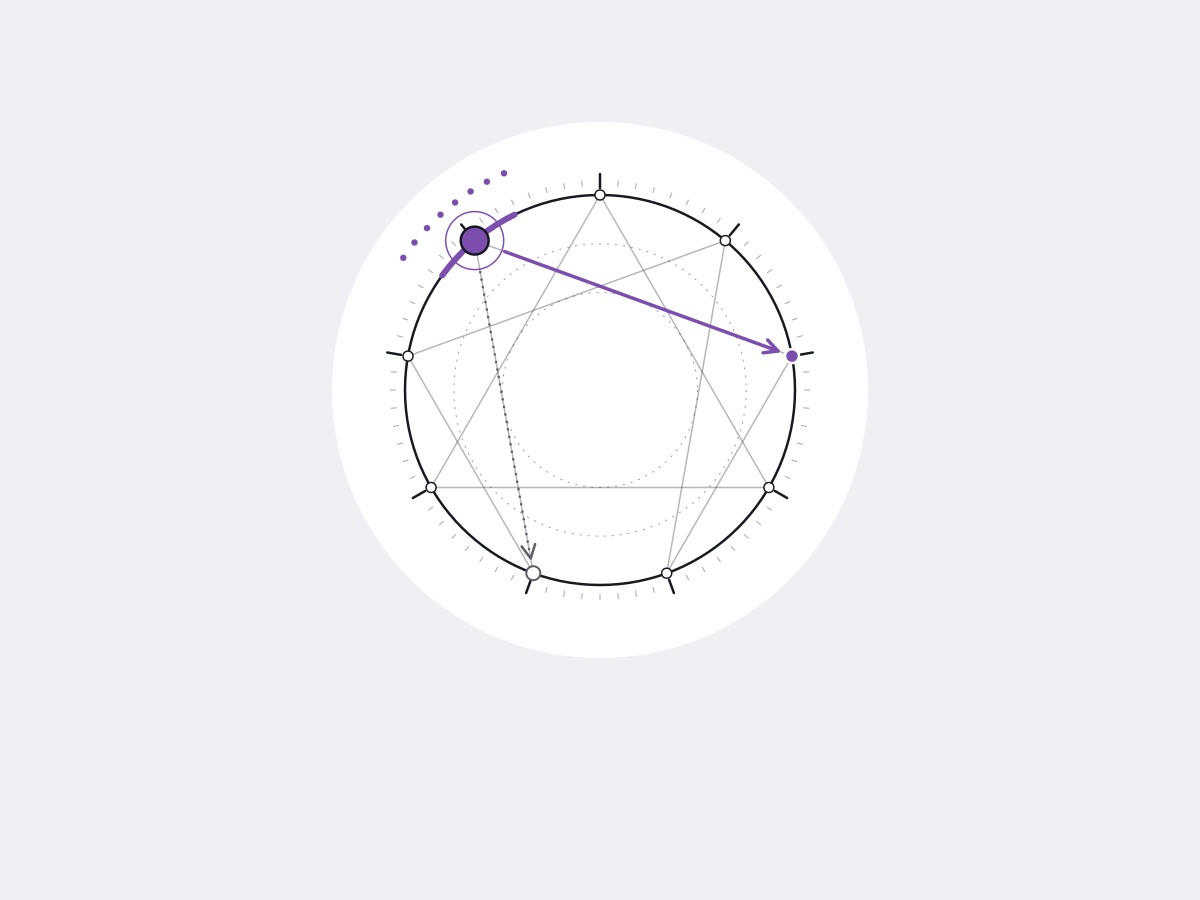

Enneagram Type 8, the Powerhouse, is one of the nine Enneagram types. Eights tend to lead with strength, directness and a drive to stay in control of their own life. They often step in to protect people who seem weaker or treated unfairly.
What is a Type 8?
A Type 8 is someone whose attention goes to power: who has it, who is misusing it, and how to stay free of anyone's control. Many Eights are bold, honest and protective. Under the tough shell, there is often a tender heart they guard closely. This is a common pattern, not a rule.
Imagine a meeting where someone takes credit for a quiet coworker's work. Most people shift in their seats. An Eight is likely to say it out loud: "Hold on. That was Maya's idea." The room goes still. Some people are grateful. Some are uneasy. The Eight barely notices. Fairness matters more than comfort.
That moment shows a lot about this type. Eights tend to act first and soften later, if at all. They trust people who are straight with them. They lose respect for people who hedge, hide or play games.
The gift of an Eight is courage. They take on hard jobs. They speak up when others stay quiet. They can carry a heavy load and still make others feel safe.
The growth edge is softness. A life built around strength can leave little room for doubt, need or hurt. Many Eights learn, slowly, that letting someone see their soft side is not weakness. It may be the bravest thing they do.
Eights belong to the body center, with Type 9, The Harmonizer and Type 1, The Principled. The body types share a strong link to gut feeling and anger. A Nine tends to push anger out of view. A One tends to hold it in and turn it into standards. An Eight tends to let it out, often in a big, clear way.
Type 8 at a glance
| Trait | Type 8, the Powerhouse |
|---|---|
| Center | Body (gut instinct and action) |
| Core fear | Being controlled, harmed or powerless |
| Core desire | Strength and control over their own path |
| Focus | Power, fairness and who needs protecting |
| Strength | Courage, honesty, decisive leadership |
| Growth edge | Letting others in and showing tenderness |
| Wings | 8w7, 8w9 |
| Stress line | Toward Type 5, The Scholar |
| Growth line | Toward Type 2, The Nurturer |
| Classic vice | Lust: a craving for intensity in everything |
| Classic virtue | Innocence: meeting life fresh, without armor |
What drives an Eight?
Many Eights are driven by a need to stay strong and steer their own life. The core fear is being controlled, hurt or made powerless. The core desire is strength and self-direction. So Eights tend to protect their people, face problems head-on and say what others only think, even when it costs them comfort.
Core fear: losing control
Many Eights carry a deep worry about being at the mercy of others. Being lied to, pushed around or made to feel small can trigger a strong reaction. Often this fear goes back to early moments when they felt they had to grow up fast or stand up for themselves.
You may see it in small ways. An Eight may sit facing the door. They may test a new boss to see if the boss is honest. They may refuse help even when they need it, because help can feel like a debt.
Core desire: strength and self-direction
What Eights want is to feel strong and to choose their own way. They want to be the one making the calls in their own life. For many, this looks like starting a business, leading a team or simply being the person others turn to in a crisis.
Core motivation: protect and meet life head-on
Eights tend to act from a wish to protect themselves and their people. They want to face problems directly rather than tiptoe around them. They often say what everyone else is thinking. They would rather have a loud, honest fight than a quiet, polite lie.
The classic vice and virtue
In older Enneagram teaching, the passion for Type 8 is usually called lust. This is not mainly about romance. It points to a hunger for intensity: big flavors, big projects, big feelings, as if life at low volume is not quite real.
The matching virtue is usually called innocence. It means meeting each moment fresh, without bracing for a fight. An Eight in touch with innocence can trust, play and be surprised. Their strength stays, but they no longer need to prove it.
What is under an Eight's armor?
People who meet an Eight often see the armor first: the firm handshake, the steady stare, the quick "no". Those who get close often find something else. Many Eights are deeply tender. They may cry at a film about a loyal dog. They may quietly pay a friend's rent and never mention it again.
So why the armor? For many Eights, an early lesson was that softness got punished or used against them. Maybe they had to protect a younger sibling. Maybe they saw what happened to people who were weak. They learned to lead with strength and keep their soft side locked away.
The armor works. It keeps them safe and gets things done. The cost is that it can keep out love as well as harm. A partner may feel they never see the "real" Eight. The Eight may feel lonely in a crowd of people who respect them but do not truly know them.
A helpful question for an Eight is: "What would I do here if I knew I was safe?" The answer often points toward a softer move. A hug instead of a lecture. A request instead of an order. Telling someone "that hurt" instead of hitting back.
Anger as information
Eights tend to feel anger fast and in the body: a hot face, tight jaw, a surge of energy. For them, anger is not a problem to hide. It is a signal that something is wrong and needs to change.
That signal is useful. It helps Eights fight for fairness. The growth step is to slow the gap between feeling anger and acting on it. A few breaths can turn a blast into a clear, strong boundary. People then hear the message instead of just the volume.
A typical week
- Monday: A vendor misses a deadline. The Eight calls them directly and gets a new date by noon.
- Tuesday: A friend is being treated badly by a landlord. The Eight drafts the letter.
- Thursday: Their partner says, "You never ask how I feel." It stings more than they show.
- Saturday: A long hike alone. For a few hours, there is nothing to fight and nothing to guard.
How do the wings shape an Eight?
On the Enneagram circle, Type 8 sits between Type 7 and Type 9. Those two neighbors are its wings. An Eight may lean clearly toward one, or draw on both.
Type 8 with a 7 wing (8w7)
An Eight who leans toward Seven tends to be outgoing, fast and full of drive. They often love big goals and big adventures. They can be charismatic and funny, with a large presence in any room.
At their best, 8w7s are bold builders who make things happen and bring people along. On a hard day, they can be impulsive, take on too much and run over people who move slower. Read more on the 8w7 wing page.
Type 8 with a 9 wing (8w9)
An Eight who leans toward Nine tends to be calmer, steadier and more quiet in their strength. They may not raise their voice often. When they do, people listen. They often have a solid, grounded feel, like a large tree.
At their best, 8w9s are protective, patient leaders who make others feel safe. On a hard day, they may hold anger inside until it bursts out, or dig in and refuse to budge. Read more on the 8w9 wing page.
Move the slider to see which wing shapes the type more.
Balanced between 8w7 and 8w9
8w7
An 8w7 is a Type 8 who leans toward Type 7. Many are bold, energetic and enterprising, with a big presence and an appetite for challenge. They protect their people and push hard for what they want. They grow by letting others see their softer side and by using their strength to lift people up.
Read more about 8w78w9
An 8w9 is a Type 8 who leans toward Type 9. Many are calm, steady and quietly powerful, with a protective presence people can lean on. They rarely start fights but are hard to move once they take a stand. They grow by showing tenderness openly and by speaking up before anger builds.
Read more about 8w9What happens to an Eight under stress?
Under steady pressure, many Eights take on traits of Type 5. The loud, active Eight goes quiet, pulls back from people and guards their energy. Trust drops, and they may brood or cut people off. This line has a healthy side too: a pause to think and gather facts before acting.
For Eights, the stress line on the Enneagram diagram points to Type 5, The Scholar.
This is often a surprise. The loud, active Eight goes quiet. A stressed Eight may pull back from people, stop sharing plans and spend hours alone thinking or researching. They may feel drained and guard their energy closely. Trust drops even further.
Why does this happen? When pushing harder stops working, the Eight retreats to regroup. It can look like a general leaving the battlefield to study the map. Sometimes this helps. Sometimes it turns into brooding and cutting people off.
Signs an Eight may be under heavy stress:
- They stop returning calls, even from close friends.
- They get secretive about plans or money.
- They feel tired in a way rest does not fix.
- They expect betrayal and look for proof of it.
- They swing between shutting down and sudden outbursts.
The Five side also has a healthy face. A stressed Eight can use it to pause, think before acting and gather facts. The key is to notice when a smart pause turns into a wall.
How does an Eight grow?
Many Eights grow by moving toward Type 2. They let their warmth show, ask how others are doing and use their power to help people grow. They learn to accept help without feeling weak. They still speak the truth and stand up for others, but with an open hand as well as a fist.
The growth line for Eights points to Type 2, The Nurturer. For a type that values strength, this means learning that care is a kind of strength too.
A growing Eight lets their warmth show. They say "I missed you" out loud. They ask how someone is doing and wait for the answer. They use their power to help others grow, not just to protect them. They can receive help without feeling weak.
Many Eights describe this as a relief. Holding up the world alone is tiring. Letting people in means sharing the weight. It also means being known, not just respected.
Growth does not turn an Eight into a pushover. They still speak the truth. They still stand up for people. The difference is that their strength now has an open hand as well as a fist.
What do health states look like for Type 8?
We use three health states: thriving, everyday and stressed. They are not ranks or fixed steps. A person can move between them, sometimes in a single week.
| State | What it can look like for an Eight |
|---|---|
| Thriving | Generous, protective and big-hearted. Uses power to lift others. Open to being moved. |
| Everyday | Direct, confident and busy. Takes charge. Can come across as intense or blunt. |
| Stressed | Controlling or withdrawn. Expects betrayal. Anger flares or goes cold. |
Thriving
A thriving Eight is a force for good. They stand up for others with calm confidence. They mentor, build and protect. They can laugh at themselves. They let people they trust see their soft side, and they are moved by beauty and kindness.
Everyday
In an everyday state, Eights are strong, busy and direct. They make quick calls and expect others to keep up. They may test people's loyalty without meaning to. Their honesty is a gift, but it can land harder than they intend.
Stressed
When stress takes hold, an Eight may grip control tightly or pull away from everyone. They may see threats in small slights. Anger may come fast and big, or go cold and silent. If this pattern lasts, reaching out to a licensed professional can be a strong and wise step.
How do instincts change an Eight?
Three instincts shape how each type plays out: Self-Preservation, Social and One-to-One (also called sexual). One tends to lead. The idea that each type takes three instinct-shaped forms is credited to Claudio Naranjo. What follows is our own description.
Self-Preservation Eight
These Eights focus their strength on survival and resources. They want to make sure they and their people have what they need: money, a home, a plan. They tend to be practical and blunt, with few words. They may struggle to trust anyone else to provide. Read more on the Self-Preservation 8 page.
Social Eight
These Eights direct their protective drive toward groups and causes. They often stand up for the underdog and fight for fairness in their community. They can be loyal friends and fierce allies. Their growth edge is letting others protect them sometimes. Read more on the Social 8 page.
One-to-One Eight
These Eights bring intensity to close bonds. They may want a deep, all-in connection and test a partner's strength. They can be magnetic and bold. The risk is trying to control the people they love most. Read more on the One-to-One 8 page.
What is an Eight like in relationships?
Loving an Eight can feel like having a bodyguard and a best friend in one. Eights are often fiercely loyal. If you are in their circle, they will go to great lengths for you. They tend to show love through action: fixing things, solving problems, standing up for you in public.
What Eights often need from a partner:
- Honesty, even when it is hard to hear.
- Someone who will stand their ground and not be a doormat.
- Space to be intense without being labeled "too much".
- Patience as they learn to share softer feelings.
Where things get hard:
- Control. An Eight may make decisions for both people without asking.
- Conflict style. Eights may see a fight as a way to get close. Partners who avoid conflict can feel run over.
- Hidden hurt. An Eight may hide pain behind anger. A partner may only see the heat, not the wound.
In a healthy relationship, an Eight learns that letting someone care for them does not make them weak. Their partner learns that an Eight's bluntness usually means trust, not contempt.
Eights with other types
Any two types can make a strong bond. A few pairings that often come up:
- Type 2 and 8: warmth meets strength on the growth line.
- Type 5 and 8: the stress line pair, often a mix of respect and distance.
- Type 6 and 8: loyalty and protection, with trust at the center.
- Type 8 and 9: a classic pull between force and calm.
- Type 8 and 8: two strong wills, high energy and some sparks.
Try the pair picker on our compatibility page to compare any two types.
What is an Eight like at work?
At work, Eights often rise to lead. They like clear authority and the freedom to make calls. They tend to be decisive in a crisis and willing to take the blame when things go wrong. People often feel safe with an Eight in charge, as long as the Eight is fair.
Common strengths at work:
- Clear, fast decisions under pressure.
- A sense of fairness and standing up for the team.
- Comfort with risk and big challenges.
- Straight talk that cuts through confusion.
Common growth edges at work:
- Taking over projects instead of sharing them.
- Coming across as harsh in feedback.
- Struggling with leaders they do not respect.
- Ignoring signs of burnout in themselves.
Many Eights do well with real responsibility and room to act. Pairing their drive with patient listening can make them powerful leaders.
Enneagram types can help a team talk about how they work. They should never be used to pick, rank or promote people. For more on work styles, see our Type 8 careers page.
Growth practices for Eights
Small steps work better than big vows. Try one of these.
- Ask before you act. Once this week, ask "What do you think?" before you decide for a group. Wait for the full answer.
- Name one soft feeling. When you notice anger, ask what is under it. Hurt? Fear? Sadness? Say it to one trusted person.
- Let someone help. Accept an offer of help, even if you could do it faster yourself.
- Lower the volume. In your next tough talk, speak at half your usual force. Notice how people respond.
- Check your body. Eights often run on fumes. Take a real rest day and do not fill it with tasks.
- Say thank you in detail. Tell someone exactly what they did that helped you.
- Practice the pause. Before sending a sharp message, wait ten minutes and reread it.
- Play without winning. Try a game or sport just for fun, without keeping score.
Is it Type 8 or another type?
Eights are most often mixed up with Types 3, 6, 1, 7 and 9. The clearest clue is motive. An Eight is guarding control, truth and fairness, and trusts their own gut first. Other types may look just as firm or bold, but for a different reason, such as success, safety, standards or fun.
Eights are sometimes confused with other strong types. Here is how to tell them apart.
- Type 8 or Type 3? Both are driven and confident. A Type 3, The Driver often adapts to what others admire. An Eight cares more about control and truth, even if it makes them unpopular.
- Type 8 or Type 6? Some Sixes cope with fear by charging toward it. A Type 6, The Steadfast often has doubt underneath. An Eight tends to trust their own gut first.
- Type 8 or Type 1? Both can be firm and blunt. A Type 1, The Principled pushes for what is right by a standard. An Eight pushes for what they want and what feels fair.
- Type 8 or Type 7? Both are bold and fast. A Type 7, The Optimist seeks fun and options. An Eight seeks impact and control. Read more on the 7 and 8 page.
- Type 8 or Type 9? An Eight with a 9 wing can look calm. A Type 9, The Harmonizer avoids conflict. An Eight will face it when it matters.
If you are torn, our test shows a confidence level and the types closest to your result.
Who is commonly typed as an Eight?
No one can type another person with certainty. Only you know what drives you. These public figures and characters are often discussed as Eights by fans and writers. They are talking points, not proof.
- Martin Luther King Jr. is sometimes typed as an Eight for his fierce stand against injustice, though others see him as a different type.
- Serena Williams is often typed as an Eight for her power and drive on the court.
- Toph Beifong from Avatar: The Last Airbender is a popular fictional example: blunt, fearless and protective.
- Miranda Priestly from The Devil Wears Prada is often discussed as an Eight, and sometimes as a Three.
People disagree on many of these. That disagreement is a good reminder that type is about inner motives, not outer style.
How reliable is a Type 8 result?
The Enneagram can be a helpful tool for reflection. The research on it is mixed, and no test can be certain about who you are. Treat any result as a hypothesis to check against your life. You can read how our test works on our methodology page.
If Type 8 fits, read the pages for Types 3, 6 and 9 too. Notice which one describes your inner world when no one is watching.
Frequently asked questions
What is Enneagram Type 8?
Type 8, the Powerhouse, is a body-center type. Eights tend to focus on strength, control and protecting the people they care about, and they often speak bluntly.
What is the core fear of a Type 8?
Many Eights fear being controlled, harmed or left powerless. They tend to stay strong and alert so no one can take advantage of them.
What are the two Type 8 wings?
An Eight can lean toward Type 7 (8w7), which is more outgoing and fast-moving, or toward Type 9 (8w9), which is calmer and more steady.
What happens to an Eight under stress?
Under stress, many Eights take on traits of Type 5. They may pull back, go quiet, guard their energy and plan in private.
How does a Type 8 grow?
Many Eights grow by moving toward Type 2. They let their care show openly and use their strength to lift others up.
Are Eights angry people?
Not always. Eights often feel anger quickly and show it openly, but it can pass fast. Many are deeply loyal and tender with the people they trust.
Are Type 8 women different from Type 8 men?
The core pattern is the same. Some Eight women report getting more pushback for being direct, which can shape how they show their strength.