Type 1
Enneagram Type 1: The Principled
Type 1, the Principled, wants to live rightly and improve the world. Learn the core fear, wings, stress and growth lines, and how Ones grow.
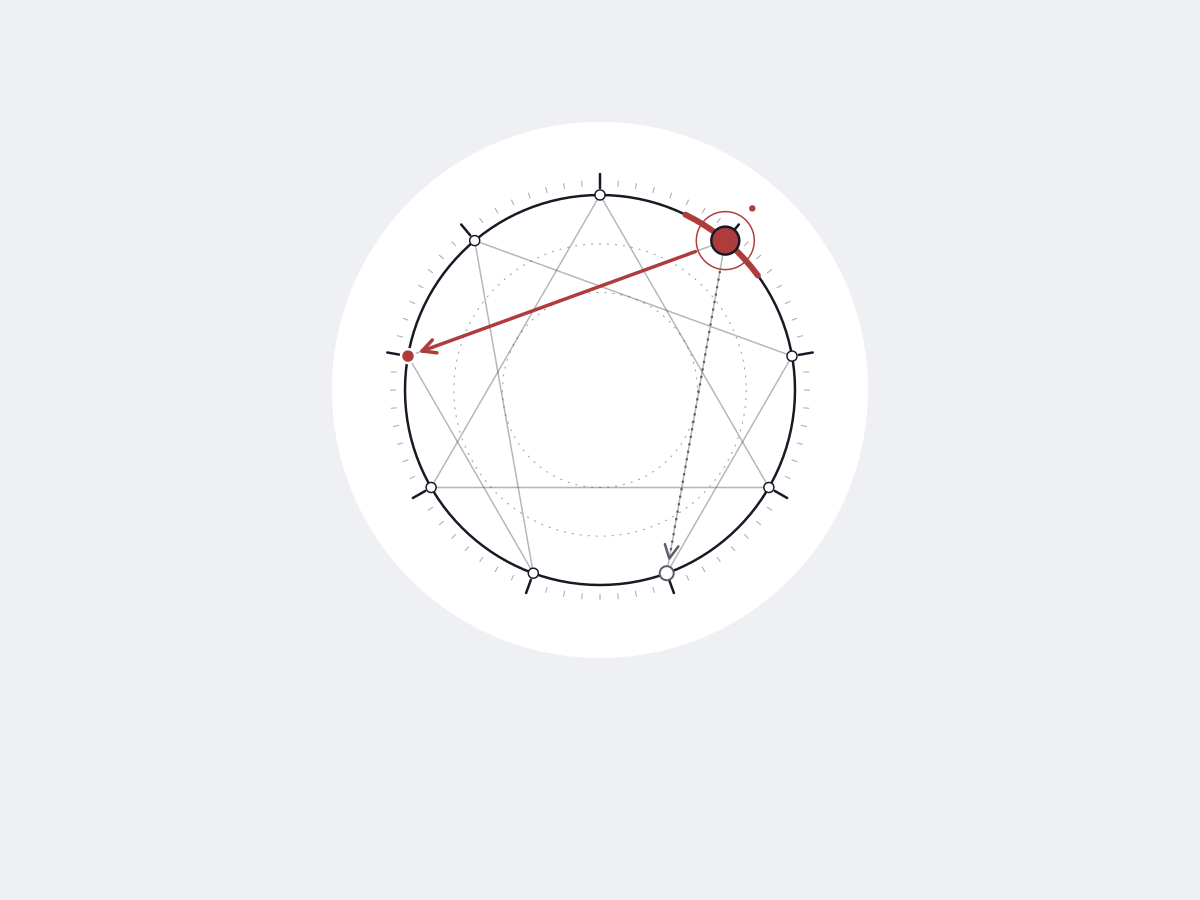

Enneagram Type 1, the Principled, is one of the nine Enneagram types. Ones tend to carry a strong inner sense of right and wrong. They notice what could be better and feel responsible for improving it, starting with themselves.
What is a Type 1?
A Type 1 is someone whose attention goes first to how things should be. Many Ones are honest, dependable and willing to do the hard, careful work others skip. The same drive can become a strict inner voice that rarely lets them rest. It is a pattern of attention, not a fixed label.
Picture a person who reads the instructions before building the shelf. They check the level twice, notice a scratch no one else will see, and feel a small sting about it all evening. That is a common One moment. It is not about the shelf. It is about a quiet feeling that things ought to be done properly, and that they are the one who has to make sure.
Ones sit in the body center, along with Types 8 and 9. Body types tend to react first with a gut sense of what is happening. For Ones, that gut sense often shows up as "this is not right yet." They feel the gap between what is and what could be, and they want to close it.
Many Ones describe a running commentary in their heads. It points out mistakes, compares the result to an ideal and reminds them of what still needs work. Some people call this the inner critic. For a One, it can feel less like a critic and more like plain reality. Learning to hear it as one voice among many is a big part of growth for this type.
None of this means every One is uptight or rigid. Many are funny, generous and deeply kind. Their high standards often come from love: for people, for good work, for fairness. The trouble starts when those standards stop being tools and become a weight they carry everywhere.
Type 1 at a glance
| Trait | Type 1 |
|---|---|
| Center | Body (gut) |
| Core focus | Doing what is right and improving it |
| Core fear | Being careless, wrong or off course |
| Core desire | To live rightly and make things better |
| Wings | 1w9, 1w2 |
| Stress line | Type 4, The Original |
| Growth line | Type 7, The Optimist |
| Common gift | Integrity and follow-through |
| Common trap | Resentment and harsh self-judgment |
| Vice to virtue | Anger to serenity |
What drives a Type 1?
Ones are driven by a wish to be good and to get things right. Their core fear is being careless or morally off course, so they watch their own actions closely. Underneath, many Ones hope that if they do everything properly, they will finally be allowed to relax and feel at peace.
Core fear
The core fear of Type 1 is being wrong in a way that matters: careless, sloppy or out of line with their values. This is not only about small errors. It is a deeper worry that if they stop watching themselves, something bad or unfair will slip through. Many Ones learned early that being good was the safest way to belong.
Core desire
The core desire is to live with integrity and leave things better than they found them. Ones want their inside and outside to match. When they act on their values and the result holds up, they feel a clean, quiet satisfaction that few other things give them.
Core motivation
In daily life, this turns into a motivation to meet their own standards and correct what is broken. A One might stay late to fix a report no one asked them to fix. They might speak up when a rule is applied unfairly, even if it costs them. They tend to feel that if they can see a problem, they are responsible for it.
Anger and serenity
The traditional vice linked to Type 1 is anger. For most Ones, though, it rarely looks like shouting. It looks like a tight jaw, a clipped tone or a long list of quiet grievances. Many Ones believe that good people do not get angry, so they push the feeling down. It leaks out as resentment, judgment or tension in the body.
The matching virtue is serenity. This is not giving up on standards. It is the ability to accept what is, while still caring about what could be. A serene One can notice a flaw, decide whether it matters, and let it go if it does not.
What are the Type 1 wings?
The two Type 1 wings are 1w9 and 1w2. A wing is a neighboring type on the circle that adds its flavor to your main type. Ones with a 9 wing tend to be calmer, more private and more abstract. Ones with a 2 wing tend to be warmer, more outspoken and focused on helping people.
Most people lean toward one wing, but some feel balanced between both. Your wing does not change your core motive. It changes how that motive shows up.
1w9
A One with a Nine wing often seems cool, steady and composed. They may care deeply about ideals like fairness or truth, but express it in a reserved way. Many 1w9s prefer to work on their own and can seem detached until a principle they hold is threatened. Their stress can come out as quiet withdrawal rather than open frustration. Read more on the 1w9 wing page.
1w2
A One with a Two wing tends to point their standards toward people. They want to improve lives, not just systems. Many 1w2s are teachers, mentors or advocates at heart. They can be warm and generous, but also more likely to tell others what they should do. Read more on the 1w2 wing page.
Move the slider to see which wing shapes the type more.
Balanced between 1w9 and 1w2
1w9
A 1w9 is a Type 1 who leans toward Type 9. Many are calm, reserved and quietly firm about what is right. They often prefer to improve things through careful example rather than loud debate, and they grow by letting their feelings, including anger, be part of the conversation.
Read more about 1w91w2
A 1w2 is a Type 1 who leans toward Type 2. Many are warm, earnest and driven to make things better for real people, not only in principle. They teach, advocate and pitch in. They grow by trusting others to find their own way and by caring for themselves as kindly as they care for others.
Read more about 1w2What happens to a One under stress?
Under ongoing stress, many Ones move along their stress line toward Type 4. They may feel that nobody understands how hard they try. They can withdraw, dwell on what is missing and sink into moody self-criticism. Spotting this shift early helps a One step back and ask for support.
A One usually holds a lot in. They keep going, follow the rules and do what is expected, often without asking for much in return. When that goes on too long, the pressure builds. Moving toward Type 4 can feel like a sudden flood of feeling after a long stretch of control.
Signs of the stress line in a One can include:
- Feeling unappreciated or envious of people who seem to live more freely
- Pulling away from friends and stewing alone
- Thinking "nothing I do is ever enough"
- Swinging between rigid control and feeling too tired to care
This shift is not all bad. It can be a signal that their feelings need attention. A One who notices "I am starting to feel misunderstood" can treat that as a cue to rest and talk to someone, rather than as proof that they have failed.
How does a One grow?
Along the growth line, Ones take on healthy traits of Type 7. They loosen up, get curious and enjoy life without needing to earn it first. Growth for a One often means trusting that the world will not fall apart if they rest, play or let a small thing stay imperfect.
Growth toward Type 7 looks like spontaneity and lightness. A One on the growth line might take a day off without a reason. They might try something new just because it sounds fun, or laugh at their own mistake instead of replaying it. These may sound like small things. For a One, they can feel like a big release.
It helps to know that growth is not a switch. Most people move back and forth. The point is not to become a different type. It is to have more choices than your habits give you.
What do the health states look like for Type 1?
Ones show up very differently depending on how they are doing. When thriving, they are wise, fair and at ease. In everyday mode, they are careful, responsible and a bit tense. When stressed, they can become rigid, critical and resentful. Most people move between these states during a normal week.
| Health state | What it can look like in a One |
|---|---|
| Thriving | Calm, wise and fair. Holds high standards with kindness. Accepts that people, including them, are human. |
| Everyday | Organized, dependable and conscientious. Notices errors fast. Feels a steady hum of "I should". |
| Stressed | Rigid and judgmental. Snaps at small mistakes. Feels resentful that others do not try as hard. |
These are rough sketches, not stages. You may recognize all three in yourself in the same day. The aim is to notice which state you are in, not to grade yourself on it.
How do the instincts shape Type 1?
Each type comes in three instinct variants: Self-Preservation, Social and One-to-One. The instinct you lean on most shapes where a One's standards show up. Some focus on health and home, some on groups and fairness, and some on close relationships and passion for a cause.
The idea of instinctual subtypes as a concept comes from Claudio Naranjo. Here we describe it in our own words, as a lens for noticing patterns rather than a set of fixed boxes.
Self-Preservation Ones
Self-Preservation Ones point their care at their own life: health, money, home and daily routines. They may be the friend who plans meals, keeps careful budgets and worries when things are out of order. They often seem warm and friendly on the surface while carrying a lot of private worry.
Social Ones
Social Ones focus their standards on the group. They care about doing things the right way in public and may see themselves as a model for others. They can be thoughtful teachers and leaders, but they may also come across as formal or hard to reach.
One-to-One Ones
One-to-One (sometimes called sexual) Ones bring their intensity to close bonds and causes they love. They may want to improve a partner or push hard for a mission. They are often the most openly passionate Ones, and the most likely to show their anger directly.
What are Ones like in relationships?
In relationships, Ones tend to be loyal, honest and responsible. They show love by showing up and doing things well. Their challenge is that their standards can spill onto partners and friends as correction or criticism. Many Ones do best with people who appreciate their effort and help them relax.
A One partner often shows care through action. They fix the leaking tap, remember the dentist appointment and keep their word. Their love language may sound like "I made sure it was done right." That can be easy to miss if you are waiting for big words.
Here are some patterns many Ones notice in close relationships:
- They keep score quietly. A One may not say they are upset, but they remember.
- They apologize hard. When they get it wrong, they may feel it more than you do.
- They improve. They often want the relationship to grow and may suggest ways to make that happen.
- They need permission to rest. A partner who says "it can wait" can be a real gift.
Tips for loving a One
- Notice and name their effort, even for small things.
- Disagree with the idea, not the person. Ones take criticism of their character hard.
- Invite fun without making it one more task to get right.
- Be on time and keep your word. It means more to a One than you might think.
For specific pairings, see the 1 and 2 compatibility page, the 1 and 7 page or the 1 and 9 page. Every pair can work well. What matters most is how two people handle stress and grow together.
What are Ones like at work?
At work, Ones are often careful, ethical and committed to quality. They catch mistakes, follow through and hold steady under pressure. Their growth edge is learning to delegate, accept good enough and give feedback in a way that encourages people instead of only pointing out flaws.
Many Ones are the person a team relies on to make sure it gets done right. They read the fine print, notice risks and build systems that last. They often feel a strong sense of duty toward the work itself, not just the boss or the paycheck.
Common strengths at work:
- Attention to detail and quality
- Clear sense of fairness and ethics
- Reliable follow-through on promises
- Willingness to speak up when something is wrong
Common growth edges at work:
- Taking on too much because "it is faster if I do it"
- Getting stuck polishing work that is already fine
- Giving feedback that feels harsh, even when it is meant to help
- Feeling resentful when others cut corners
Your type does not decide which job you should have. Ones thrive in many fields. What tends to help is work that lets them care about quality, with enough freedom to set their own standards and enough support that they do not carry everything alone. This is about self-awareness and communication, never about selecting people for roles. See careers for Type 1 for more ideas.
What are common myths about Type 1?
The biggest myth is that every One is a neat freak who loves rules. In reality, Ones vary a lot. Their standards may center on ethics, craft, health or fairness rather than tidiness. Many Ones are playful and warm, and many break rules they see as unfair. The common thread is an inner sense of "should".
Because Ones are often described in a few quick words, people tend to flatten them. Here are some ideas worth questioning.
Myth: Ones are always tidy. Some Ones keep a spotless home. Others have messy desks and very precise views on, say, how a piece of music should be played. The standard can land anywhere. What stays the same is the feeling of a right way and a wrong way.
Myth: Ones love rules. Ones love what is right, which is not the same thing. Plenty of Ones push back hard against rules they see as unjust. They may be the first to question a policy that hurts people, and the last to let it slide.
Myth: Ones are cold. A One's care can be quiet and practical, so it is easy to miss. They may not gush, but they will remember what matters to you and make sure it gets done. Many Ones feel things deeply and simply keep those feelings private.
Myth: Ones think they are better than everyone. Most Ones are much harder on themselves than on anyone else. When they do criticize others, it often comes from the same voice they use on themselves all day. Knowing this can make their comments easier to hear, and easier to push back on.
Myth: Ones cannot relax. Ones can relax. They often just need the work to feel finished first, or a clear reason to believe that rest is allowed. A One on vacation, once they settle in, can be one of the most present people you know.
Is Type 1 commonly confused with other types?
Yes. Ones are often confused with Types 6, 3 and 5, since all can look careful or driven. The key is the motive. Ones act from an inner sense of right and wrong. Sixes act from a need for safety, Threes from a wish to succeed, and Fives from a need to understand.
| Question | Type 1 | Type 6 | Type 3 | Type 5 |
|---|---|---|---|---|
| Why follow the rules? | Because it is right | Because it feels safer | Because it gets results | Only if they make sense |
| What does a mistake feel like? | A personal failing | A sign of danger | A threat to their image | A gap in knowledge |
| Where does doubt come from? | An inner critic | Worry about what could happen | Fear of looking bad | Feeling unprepared |
If you see yourself in more than one column, that is normal. Try asking what you feel first when something goes wrong. Ones often feel "I should have done better." That inner "should" is one of the clearest signs of the type.
What growth practices help a Type 1?
Helpful practices for Ones build gentleness toward themselves and room for joy. Examples include noticing the inner critic without obeying it, scheduling unstructured play, naming anger early and asking whether a mistake will matter in a week. Small, steady practices work better for Ones than big resolutions.
Try one of these for a week. Pick the one that feels easiest, not the one that feels most worthy.
- Name the critic. When you hear "you should have," label it: "That is my critic talking." You do not have to argue with it. Just notice it.
- Use a "good enough" line. Before you start a task, decide what done looks like. Stop there.
- Plan time with no purpose. Block an hour each week for something fun that produces nothing.
- Catch anger early. Notice tension in your jaw, shoulders or hands. Ask, "What am I annoyed about right now?"
- Ask the one-week question. When a mistake stings, ask whether it will matter in a week. If not, let it go.
- Say thank you for effort. Thank people, including yourself, for trying, not only for getting it right.
These are ideas for self-reflection. If you feel stuck in harsh self-talk for a long time, talking with a licensed professional can help.
Which famous people are commonly typed as Type 1?
Public figures and fictional characters often typed as Ones include Hermione Granger, Mahatma Gandhi and Ruth Bader Ginsburg. These are guesses made by fans and writers based on public behavior. No one can know another person's type for sure, and people regularly disagree about these examples.
Here are a few names that come up often. Treat them as conversation starters, not proof:
- Hermione Granger (fictional) is often typed as a One for her rule-keeping and sense of justice.
- Mahatma Gandhi is often typed as a One for his strict personal discipline and moral focus.
- Ruth Bader Ginsburg is often typed as a One for her precise, principled approach to law.
- Confucius is often typed as a One because his teachings center on right conduct.
Typing someone you have never met is guesswork. The best use of these examples is to ask yourself what traits people are pointing to, and whether you share them.
How can you tell if you are a Type 1?
You may be a Type 1 if you often feel a gap between how things are and how they should be, and feel responsible for closing it. A strong inner critic, a quiet buildup of frustration and a deep care for fairness are common signs. Taking the test is a good next step.
Ask yourself a few questions:
- Do I notice errors before I notice what is going well?
- Do I feel guilty when I rest before the work is done?
- Do I get more upset about unfairness than about my own discomfort?
- Do I often think "if you want it done right, do it yourself"?
If most of these feel familiar, Type 1 may fit. Keep in mind that the Enneagram has mixed research support. A systematic review by Hook and colleagues found some promising results and many open questions. Use your type as a lens for self-reflection, not as a verdict. Our test shows how clearly you match each type, so you can compare Type 1 with its closest neighbors.
Frequently asked questions
What is Enneagram Type 1?
Type 1, the Principled, is a body-center type focused on doing things the right way. Ones tend to be honest, careful and driven to improve themselves and the world around them.
What are the two Type 1 wings?
Ones can lean toward 1w9, which is calmer and more reserved, or 1w2, which is warmer and more focused on helping people directly.
What does a One look like under stress?
Under stress, many Ones take on traits of Type 4. They may feel misunderstood, withdraw and get stuck in moody self-criticism.
How do Ones grow?
Many Ones grow by moving toward Type 7. They make room for play, curiosity and the idea that good enough is often good enough.
Are Ones always neat and organized?
No. Ones care about doing things right, but their standards may focus on ethics, fairness or craft rather than a tidy desk.
Which types are most often confused with Type 1?
Ones are often confused with Type 6, Type 3 and Type 5. The difference is usually in the motive behind the behavior, not the behavior itself.