Enneagram Arrows: The Stress and Growth Lines for All 9 Types
Each Enneagram type links to two others: a stress line and a growth line. See where every type goes under pressure and when it grows, with examples.
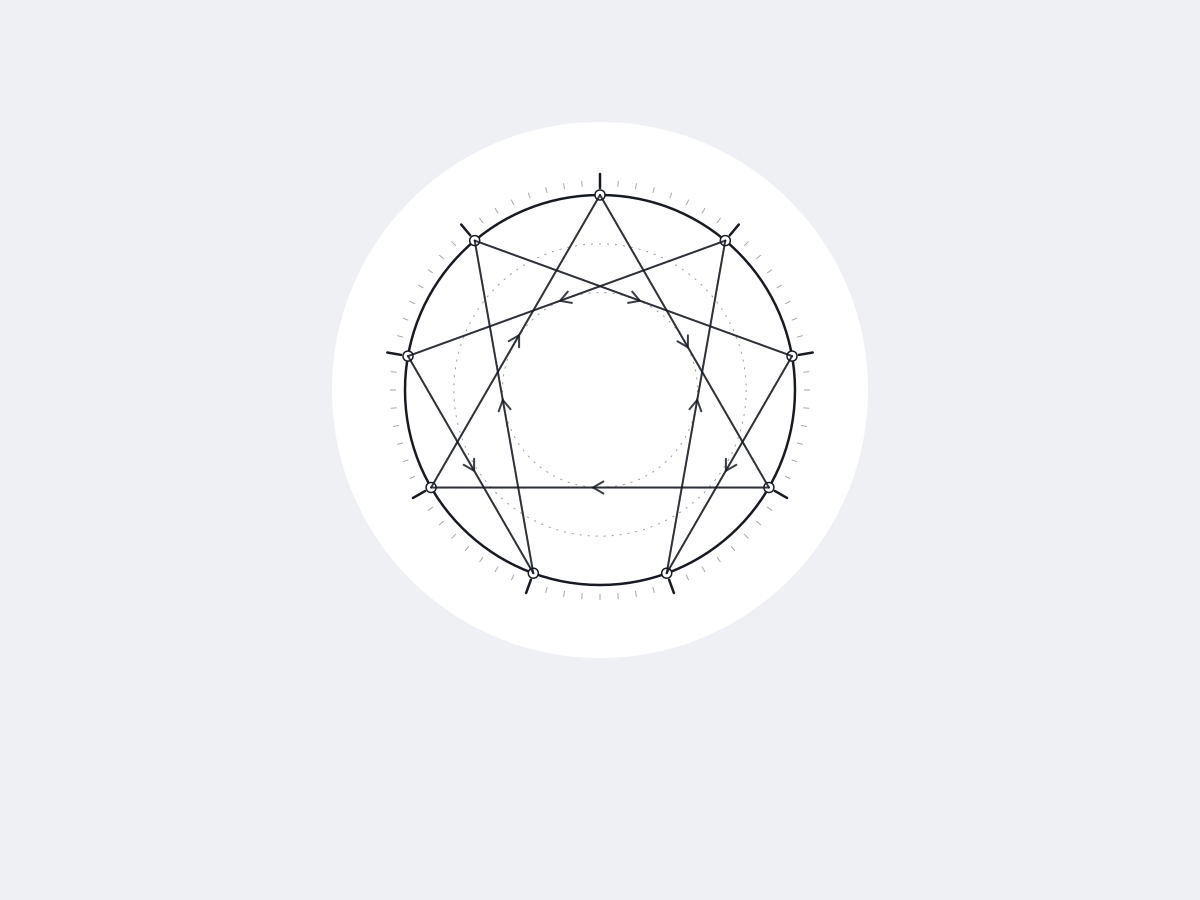
The Enneagram arrows are the lines inside the Enneagram symbol that link each type to two others. One is the stress line: habits a type may pick up under pressure. The other is the growth line: qualities a type may reach for when it feels safe.
What are the stress and growth lines?
The stress and growth lines are two paths from each type to two other types. When life is hard, a type may act more like its stress point. When a type feels secure and is stretching, it may take on the best traits of its growth point. You stay your own type either way.
Picture a calm Type 9 friend who suddenly starts worrying about every detail of a trip. Or a usually busy Type 3 coworker who, after a hard month, stops striving and zones out in front of the TV. Both are acting a little "out of type." The lines give a name to those moments.
The idea is old in Enneagram teaching, and different authors use different words. Many older books say integration for the growth line and disintegration for the stress line. In diagrams they are drawn as arrows. We use plain names because they say what each line is for.
Where does each type go under stress and in growth?
Each type has a fixed pair of lines. A Type 1 moves toward Type 4 under stress and toward Type 7 in growth. A Type 2 moves toward Type 8 under stress and Type 4 in growth. The table shows all nine, with a short note on how each line often looks in daily life.
| Type | Stress line | How it can look under stress | Growth line | How it can look in growth |
|---|---|---|---|---|
| Type 1 | Type 4 | Moody, misunderstood, withdrawn | Type 7 | Lighter, playful, more relaxed |
| Type 2 | Type 8 | Blunt, demanding, quick to anger | Type 4 | Honest about own needs |
| Type 3 | Type 9 | Flat, checked out, unmotivated | Type 6 | Loyal, team-minded, candid |
| Type 4 | Type 2 | Clingy, eager to be needed | Type 1 | Steady, focused, disciplined |
| Type 5 | Type 7 | Scattered, restless, distracted | Type 8 | Confident, quick to act |
| Type 6 | Type 3 | Image-focused, overworking | Type 9 | Calm, trusting, at ease |
| Type 7 | Type 1 | Critical, rigid, irritable | Type 5 | Focused, quiet, deep |
| Type 8 | Type 5 | Withdrawn, secretive, guarded | Type 2 | Warm, open, generous |
| Type 9 | Type 6 | Anxious, doubtful, reactive | Type 3 | Energized, goal-driven |
Each type guide covers its own lines in more depth. For example, the Type 5 guide shows what the Scholar looks like when stress pulls them toward scattered Seven energy, and what changes when they grow into the Eight's directness.
Why do the lines form those shapes?
The lines follow the inner shape of the Enneagram symbol. Types 3, 6 and 9 form a triangle, so each of them points to the other two. The remaining six types form a figure that runs 1, 4, 2, 8, 5, 7 and back to 1. Stress moves one way along it, and growth moves the other way.
You do not need to remember the geometry to use the lines. But it helps to know that the pattern is fixed. Each type always connects to the same two points. That is why a Type 7 under stress can start to sound like a strict Type 1, while a Type 1 in growth can start to enjoy life like a Type 7. The two types share a line, and travel along it in opposite directions.
Shared lines also show up in pairs. Types 2 and 8 sit on a shared line, which is one reason the 2 and 8 pair can feel so familiar to each other. The same goes for Types 3 and 6, Types 3 and 9 and Types 5 and 8.
Is the stress line always bad?
No. Many teachers say each line carries both healthy and unhealthy traits. A stressed Type 8 who pulls back like a Five may need that rest. A growing Type 2 who reaches for Four's honesty can overdo it and sink into feelings. The lines show options, not good and bad places.
It can help to treat the stress point as a signal. When you notice yourself acting like your stress type, you are probably running low on something. A One who feels moody and misunderstood may need less self-criticism and more rest. A Six who starts overworking to look impressive may need someone to trust.
The growth point is not a reward to chase, either. It shows qualities that tend to come more easily when you feel safe. You cannot force them, but you can practice them in small ways.
How do you use your lines in daily life?
Use your lines as an early warning and a gentle direction. Learn the habits of your stress point so you can spot them sooner. Pick one small habit from your growth point and practice it on a calm day. Over time, both lines make it easier to notice where you are and what you need.
- Find your type in the table above.
- Write down two stress-point habits you recognize in yourself.
- Ask what you usually need when those habits appear.
- Pick one small growth-point habit to try this week.
- Check in after a month and notice what changed.
Your lines work alongside your wing and your health state. A wing adds a steady flavor to your type. A health state shows how well you are doing inside your type right now. The lines show where you tend to move as that state changes.
How are the lines different from wings?
Wings and lines are both links to other types, but they work differently. A wing is a neighbor on the circle that colors your style most of the time. A line is a jump across the circle that shows up more in certain moments, such as a hard week or a period of growth.
| Feature | Wing | Stress and growth lines |
|---|---|---|
| Which types | The two types beside yours | Two types across the circle |
| When it shows | Most of the time | Mostly under stress or in growth |
| What it shapes | Your everyday style and tone | How you shift as life changes |
| How many | Two possible, one often leads | Exactly two, always the same |
What are the limits of the lines?
The lines are a teaching tool with little direct research behind them. Studies of the Enneagram mostly look at the core types, and that evidence is mixed. Many people find the lines useful for noticing patterns. Others do not see them in their own lives. Both experiences are common.
If the lines do not fit you, do not force them. Not every bad week is a trip to your stress point, and not every good one is growth. You can read more about what research does and does not show in our guide to whether the Enneagram is accurate.
Frequently asked questions
What are the arrows in the Enneagram?
The arrows are the inner lines of the Enneagram symbol. They link each type to two others: one it may move toward under stress and one it may move toward when it grows.
Are stress and growth lines the same as integration and disintegration?
Yes. Older books call the growth line integration and the stress line disintegration. We use stress line and growth line because they say plainly what each one means.
Does going to my stress type mean I am that type?
No. You stay your core type. Under stress you may borrow some habits of another type, but your core motivation does not change.
Is the stress line always bad?
Not always. Many teachers say each line carries both healthy and unhealthy traits. The stress point can show you what you need, and the growth point can be overdone.
Do the arrows apply to everyone?
They are a model, not a law. Many people recognize their lines, and some do not. Use them as patterns to look for, not as predictions.