Type 9 and your own routines: how to stay yourself in a relationship
Many Type 9s drift into a partner's routines to keep the peace. Learn why it happens, what to watch for, and small ways to keep your own rhythm and stay close.
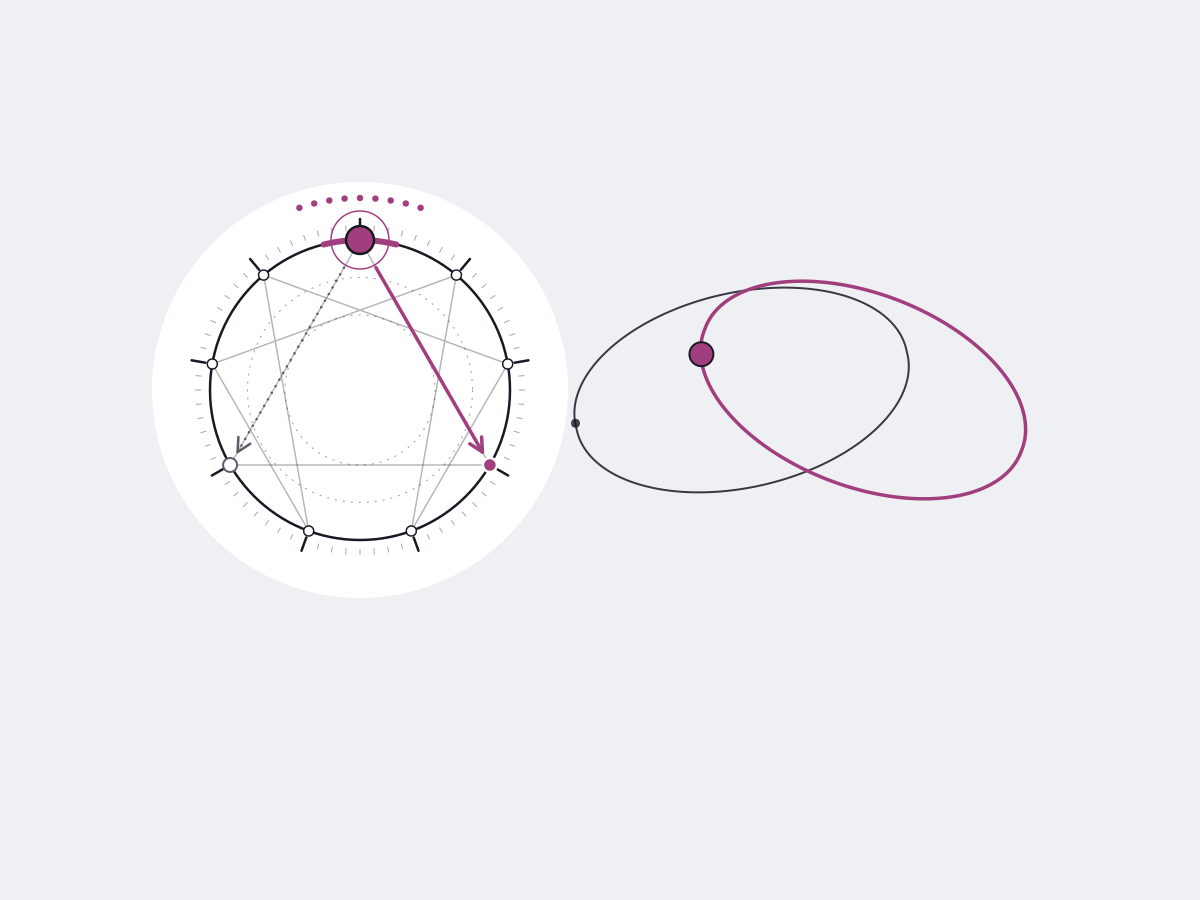

Why do Type 9s drift into a partner's routines?
Many people who lead with Type 9, the Harmonizer, slide into a partner's schedule and tastes because it keeps things calm. It rarely feels like a decision. It's dinner at 7 because your partner eats at 7, or a Saturday hike you never really chose. The way out isn't distance. Keep a few small routines that are clearly yours, and say so out loud.
Why does it happen? One popular guide to the types says Nines carry a deep fear of loss and separation, and that this can lead them to "merge" with a partner, almost falling asleep to their own wants to keep the peace. Another describes how small agreements pile up. "Thai?" "Sure." Over months, those easy yeses can add up until a preference finally surfaces, and your partner is surprised, because every earlier yes looked like a real choice.
Underneath it is a quiet question: can I take up space and still stay connected to you?
That tendency comes with real strengths. Nines are often easy to live with, good at seeing the other person's side, and calm in a way that helps a couple through a rough patch. The growth edge is making sure that calm doesn't cost you your own shape.
A quick note on sources: most of what's written about Nines in love is popular Enneagram writing, and these are tendencies people describe, not proven rules. We'll come back to that near the end.
Is it a comfortable routine, or is it merging?
Not every shared routine is a problem. Plenty of Nines find real comfort in rhythm: the same morning coffee, the same Sunday walk. One writer on the type frames routines as restorative and says the concern is when "making room for everyone" starts meaning "leaving no room for yourself."
So how do you tell the difference? It can help to know that Enneagram writers describe two different pulls inside Type 9, tied to the instincts. According to one subtype guide, a Self-Preservation Nine tends to merge with routines and physical comfort, while a One-to-One Nine tends to merge with an important person. Many Nines show some of both.
| Pull | What it can look like | What it can cost | A small step |
|---|---|---|---|
| Merging with routines | Reading, TV, puzzles, the same cozy loop every evening | Comfort can stand in for connection, or routines can become a way to avoid life | Notice when a routine feels like a choice and when it feels like a hiding place |
| Merging with a person | Taking on a partner's hobbies, schedule and opinions | Your own identity gets fuzzy, and your partner carries more of the decisions | Ask "What do I want, apart from this?" and act on one answer |
In a relationship, these can mix. You might drop your own evening routine, then lean hard on a new shared one, and miss the fact that neither is quite yours.
What are the signs your own rhythm has gone quiet?
You may notice a few of these. You don't need all of them, and none means something is wrong with you. They're just worth a look.
- Hobbies have gone dormant. You used to run, paint or play something, and you can't say when you stopped.
- Simple preference questions feel hard. "Where do you want to eat?" brings a small wave of anxiety, or a quick "wherever's fine."
- You've picked up your partner's interests. You love hiking now, but you're not sure you ever asked yourself whether you do.
- A resentment you can't name. Nothing is wrong, exactly, yet something feels flat. The same writer describes this as a slow simmer that eventually leaks out through stubbornness, going quiet, or an occasional outburst.
If two or three of these sound familiar, that's useful information, not a verdict. It just means your own rhythm could use some attention.
How can you keep your own routines without feeling distant?
Small and steady beats big and dramatic. Here are a few things to try.
Keep one routine that is only yours. A morning walk, a weekly class, an hour with a book. Tell your partner what it is and why it matters to you, and frame it as a rhythm, not a retreat. A sentence like "This is how I recharge, and I come back better for it" lands very differently from silence.
Practice preference reps. One popular suggestion is to choose the restaurant, name the movie, or disagree about one small thing each day. Another is to state one need a day. They sound tiny. That's the point. Preferences work like a muscle, and low-stakes reps make the bigger ones less scary.
Notice before you say "I don't care." Pause for a breath and check. Sometimes you really don't care. Sometimes there's a quiet "actually, I'd like to stay in tonight" underneath. Try saying that one out loud.
Give big decisions a return time. If you need to think, say so: "Let me think about it tonight, and let's decide tomorrow at breakfast." You get room to process, and your partner gets a clear promise instead of a shrug.
Reconnect on purpose. After time on your own, check in. A short walk together or a few minutes on the couch tells your partner that alone time and closeness aren't opposites. For One-to-One Nines especially, the growth work is described as separating while staying connected, and that includes the staying connected part.
How can a partner help?
If you're the partner of a Nine, a few small moves can make it easier for them to say what they want.
- Ask, then wait. Silence is often processing, not agreement. Pressing for an instant answer tends to make things harder.
- Lower the stakes. Swap "Where do you want to eat?" for "Tacos or pizza?" A narrow choice is easier to answer honestly.
- Celebrate stated preferences. When your Nine says what they want, even if it's small, say thanks. Make it feel safe to do it again.
- Ask twice. If you hear "whatever you want," it's fine to say, "I mean it. What would you pick?"
For more on how types show up in romance, see our Enneagram guide to love. If you and your partner both tend toward calm and routine, you may also like the post on two people of the same type, and the one on love languages and the Enneagram. Our communication guide has more ideas for saying hard things gently.
Can two routines share one home?
Yes. Closeness and separateness aren't opposites. Many couples do best when each person has some time and interests that belong only to them, and plenty of Nines find they're better partners for it, because they show up as a whole person instead of a reflection. One line from a Nine-focused page sums it up: true harmony doesn't require anyone to disappear.
If you want to see how your type pairs with your partner's, you can browse the compatibility pages.
What does the evidence say?
Let's be plain about this. The Enneagram is a reflection tool, not a measured science, and most of what's said about Nines in love comes from popular writing. In a published study of Enneagram trainings, the authors noted that no earlier studies had measured the effects of such programs on adult development, and that there is a lack of rigorous scientific research on the system. They found some gains in ego development among people who completed at least 40 to 50 hours of training, and they called for more controlled studies.
So hold these patterns lightly. Treat them as prompts for noticing, not as a description of who you must be. If something here rings true, try one small habit. If it doesn't, drop it.
Conclusion
If you're a Nine, your calm is a gift to your relationship. The goal isn't to become louder or more distant. It's to keep a little room for yourself: one routine that's yours, one preference said out loud each day, and a clear return time when you need to think. This week, try just one of them and see what your partner notices.
Frequently asked questions
Is it bad for a Type 9 to share a partner's routines?
No. Sharing routines is part of being close. What matters is whether you chose them or simply drifted into them. If a routine still feels good when you stop and think about it, it's yours too.
How can a Type 9 say what they want without starting a fight?
Start small and low stakes. Name one preference a day, such as the movie or the restaurant. Small, calm preferences build the habit before the bigger conversations come along.
What can a partner do when a Nine says 'whatever you want'?
Offer a narrow choice instead of an open question, then wait. Silence is often a Nine thinking. For bigger decisions, agree on a time to come back with an answer.
Does every Type 9 merge with their partner?
No. These are tendencies many Nines describe, and they vary by person and by instinct. Some Nines lean more on their own routines than on a partner. The Enneagram is a reflection tool with mixed research support, not a rule.
Sources
- Enneagram Types in Relationships: Love, Conflict & Repair (9takes)
- A Guide to Enneagram Types in Relationships (Enneagram Universe)
- The Subtypes of Enneagram Type Nine Explained (Enneagram Entrepreneur)
- Enneagram Type 9: Finding Your Voice (9takes)
- Advancing Ego Development in Adulthood Through Study of the Enneagram System of Personality (Daniels et al., 2018)